
- Nerve Impulse Transmission Webquest
- Nerve Impulse Transmission Diagram
- Nerve Impulse Transmission
- Nerve Impulse Transmission Animation
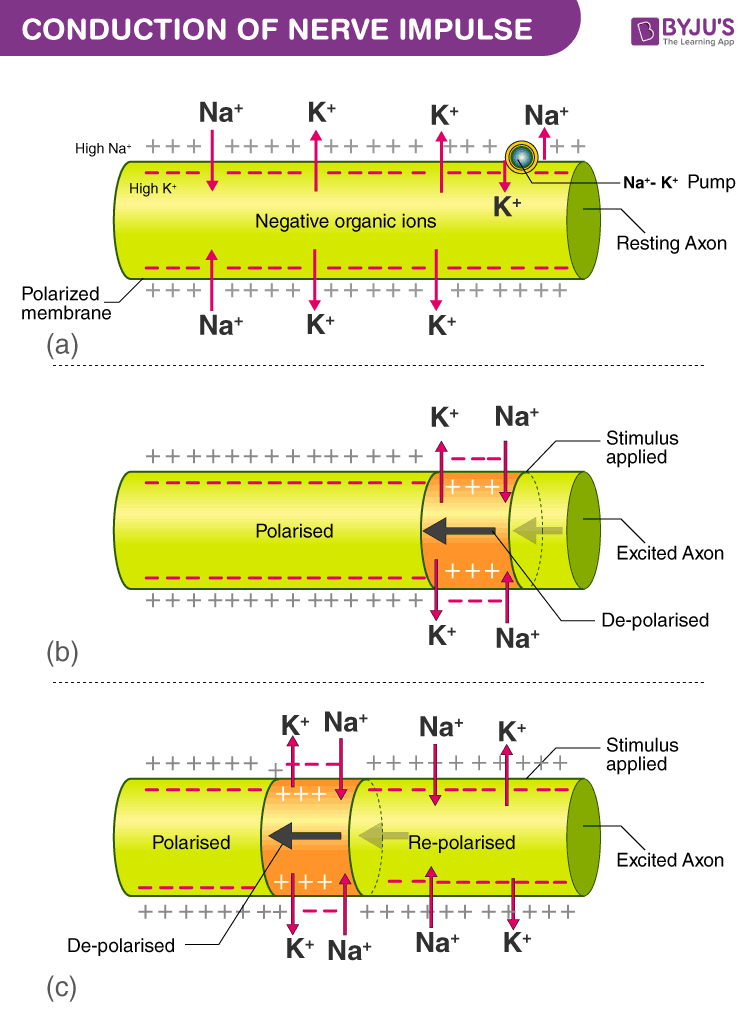
Resting potential until another impulse comes along. The following figure shows transmission of an impulse. Transmission of a nerve impulse: Resting potential and action potential. Like the gaps between the Schwann cells on an insulated axon, a gap called a synapse or synaptic cleft separates the axon of one neuron and the dendrites of the next.
- Transmission of a nerve impulse along an axon. A nerve cell is like a receiver, transmitter and transmission line with the task of passing a signal along from its dendrites to the axon terminal bundle. The stimulus triggers an action potential in the cell membrane of the nerve cell, and that action potential provides the stimulus for a.
- Origin of Nerve impulse: In resting nerve cells, the surface is positively charged and the interior is negatively charged. When the surface is stimulated the stimulated point becomes negative. The fluids both inside and outside the cell are electrolytic solution containing 150-160m Eq/litre.
- STEP 5: TRANSMISSION ACROSS THE SYNAPSE - Neurons do not touch, the axon terminals stop before reaching the dendrites of the next neuron. The gap between these two neurons is known as synapse - Impulses are carried across a synapses by neurotransmitters (chemical messengers).
Why can nerve impulses travel only in one direction?
1 Answer
Aqw ac generator download. Because of the chemical nature of impulse and the axon-dendrite structure.
Explanation:
Because of the chemical nature of impulse and the axon-dendrite structure.
http://www.biologymad.com/nervoussystem/nerveimpulses.htm (Best technical explanation and excellent graphics and animations)
The best generic answer from a 2008 post follows (with my own edits for clarity):
A Nerve electrical impulse only travels in one direction. There are several reasons nerve impulses only travel in one direction. The most important is synaptic transport.
In order for a 'nerve impulse' to pass from cell to cell, it must cross synaptic junctions. The nerve cells are lined up head to tail all the way down a nerve track, and are not connected, but have tiny gaps between them and the next cell. These tiny gaps are called synapses.
When you get a nerve firing, you have probably heard that it is an electrical impulse that carries the signal. This is true, but it is not electrical in the same way your wall outlet works. This is electrochemical energy. Neurotransmitters are molecules that fit like a lock and key into a specific receptor. Fifa 19 highly compressed pc. The receptor is located on the next cell in the line. When the neurotransmitter hits the receptor on the next cell in line, it signals that cell to begin a firing as well.
Nerve Impulse Transmission Webquest
This will continue all the way down the length of the nerve track. In a nutshell, a nerve firing results in a chain reaction down the nerve cell's axon, or stemlike section. Sodium (Na+) ions flow in, potassium (K+) ions flow out, and we get an electrochemical gradient flowing down the length of the cell. You can think of it as a line of gunpowder that someone lit, with the flame traveling down the length of it. Common electrical power is more like a hose full of water, and when you put pressure on one end, the water shoots out the other.
Nerve Impulse Transmission Diagram
Download teamviewer 4.0 free. Therefore, nerve impulses cannot travel in the opposite direction, because nerve cells only have neurotransmitter storage vesicles going one way, and receptors in one place.
Nerve Impulse Transmission
Addendum to further questions:
The impulses travel TO the CNS from the PNS. Do not confuse NERVE signals from the MUSCLE signals! Each goes ONE WAY, but together they coordinate to help use move. The following is a better description of the chemical processes involved:
https://web.facebook.com/bryant.seabrooks/videos/10208641612752284/?t=325
Nerve Impulse Transmission Animation
Related questions